

















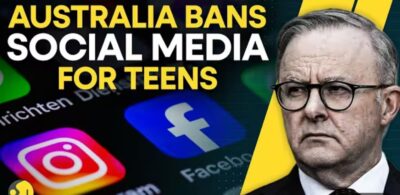
Social Media Ban for Children-A Save Childhood Movement,considered a protective shield for children in modern society amidst digital pollution, inappropriate content, violent videos, and harmful algorithms-Advocate Kishan Sanmukhdas Bhawnani,Gondia Maharashtra

Gondia – While global politics is often dominated by military tensions, economic competition, strategic alliances,and geopolitical shifts, Australia has taken a bold step that has shifted the international discourse towards child protection, digital child policy, and technological misuse. This decision did not stem from a war, sanctions or trade dispute, but is directly linked to the mental and social well-being of our families our children,and future generations Australia has made a historic social intervention by becoming the first country in the world to decide to shut down social media accounts of children under 16 years of age, a decision that has both surprised and compelled the world to reflect. This decision has directly impacted major social media platforms such as Instagram, Facebook,TikTok, YouTube, Snapchat, Threads, and X.Millions of teenagers’ accounts have been closed,and strict provisions have been made, including the possibility of imposing heavy fines of up to $32 million on tech companies if they do not comply with this policy.I,Advocate Kishan Sanmukhdas Bhawnani,Gondia, Maharashtra,believe that this step is not merely a legal amendment or an administrative order; it is a Save Childhood Movement,considered a protective shield for children in modern society amidst digital pollution,cyberbullying, mental stress,inappropriate content,violent videos, and harmful algorithms.Friends, if we talk about understanding the dark truth ofsocial media: its intrusion into children’s lives and the psychological risks, governments worldwide,tech experts, psychologists, and parents have long been concerned about the extent to which social media isaffecting children’s mental health. Reports indicate that children aged 10-16 are most active on social media,where they are exposed to unfiltered and often harmful content. Many children spend hours scrolling through videos, and the platforms’ algorithms continue to show them similar videos, which are linked to more views, more clicks, and more profits for the companies, regardless of how harmful they may be to children.According to psychologists, a child’s psyche is most affected during this age when they are in the process of developing their identity, behavior, and learning. Harmful online content such as violent videos, pornography, cyberbullying, unrealistic beauty standards, and comparisons to fake social lives can push children towards deep depression, suicidal tendencies, feelings of inadequacy, and family estrangement. Several studies prove that today’s generation is learning less from books and more from reels, and listening more to social media influencers than to their families. This is a wake-up call.
Friends, if we talk about understanding why tech companies target children and the harsh reality of their business model,a major reason behind Australia’s decision could be the algorithm-based business model of social media companies. Keeping children on the platform for as long as possible is the core element of these companies profits. Children’s interests change rapidly, they are emotionally sensitive, and easily influenced by viral content, making them the easiest consumers for these companies. The algorithms are designed in such a way that children keep watching videos,keep scrolling and cannot leave the platform. This digital addiction not only consumes their time but also cuts them off from real life and traps them in a virtual world. Friends, if we consider the AustralianSave Childhood Movement as an example for the world, Australia has completely banned social media for children under the age of 16. This decision is the first of its kind in any major democracy in the world. Some of its key aspects are:(1) Millions of teenagers’ accounts closed-strict criteria have been implemented for verifying children’s identities. (2) 10 social media apps completely banned-all major platforms, including Facebook, Instagram, TikTok, YouTube, X, Snapchat, and Threads, have been blocked for those under 16. (3) No punishment for parents, responsibility lies with tech companies – Australia understood that parents may not always understand the complexities of modern technology.Therefore, the penalties are solely on the companies. (4) Heavy fines of up to $32 million on tech companies-this will force companies to change their business strategies that target children. This step is not just about child protection; it is about restoring social values in the digital age. Many experts consider this a new era of digital fair play
Friends, if we talk about whether such a movement is necessary for the 350 million children in India, let’s try to understand this:
India is the youngest country in the world. We have approximately 350 million children under the age of 15, which is far more than the total population of many smaller countries The biggest concern for Indian parents is what their child is watching on their mobile phone, who they are talking to, what they are learning, and to what extent they are falling prey to the negative influences of social media.(1) Several worrying situations are being observed in India:(2) Children are becoming victims of cyberbullying.(3) They have started considering violence and antisocial behavior as entertainment. (4) The distance from studies is increasing. (5) Sleep, mental health,and social behavior are rapidly deteriorating.(6) Influencers have become role models for children.(7) Access to inappropriate content is constantly increasing.If we look at it, the problem in India is much deeper than in Australia, because the population is larger, mobile phone penetration is higher, and digital literacy is comparatively lower.
Friends, if we try to understand whether a social media ban in India would be significant in the direction of the Save Childhood movement, this question is extremely important, and the answer is not simple. India is a vast, diverse, and complex democracy, where social media is a major medium for freedom of expression, employment, markets, and digital access. But it is also true that the safety of children is the primary responsibility of any nation.
Implementing such a ban in India could be effective for the following reasons: (1) Protection of children’s mental health – If children under the age of 16 are kept away from social media, their emotional stability, social intelligence, and real-life experiences will improve(2) Positive impact on education – Digital distractions will be reduced in schools and homes. Children will spend more time on books, games, and real-life activities.(3) Family relationships will be strengthened – The tendency to spend time with family will increase. Children’s lives will emerge from digital isolation. (4) Pressure on tech companies: No platform’s earnings will stop as long as it values a large market like India. If India implements strict regulations, companies will be forced to change their global policies as well. (5) Digital literacy movement: This could initiate a widespread digital ethics movement in India.
Friends,Now, let’s consider the challenges facing India: Will it be easy? Implementing such restrictions in India will present major challenges: (1) The vast population and the difficulty of technological tracking (2) The complexity of digital identity verification (3) Technological infrastructure in rural areas (4) The debate on digital rights and freedom of expression (5) The issue of trust between children and parents (6) Lobbying by opposing tech companies. However, it is also true that no major reform is challenge-free. When the future of children is at stake, taking difficult paths becomes both possible and necessary.
Therefore, if we study and analyze the entire approach in detail, we will find that the question is: Is this the right time for India? Australia has shown the world a direction, demonstrating the significant role the state can play in protecting children. This is not just a technical regulation, but a visionary effort to protect society. For a country like India, with 350 million children, this decision becomes even more crucial. The fears of parents in India are also real; what children are seeing, learning, and becoming on social media affects the future of the nation. Therefore, it is time for a Save Digital Childhood Movement to begin in India. This movement can start with legislation, but it must be carried forward through the collective responsibility of society, schools, parents, and digital companies. If we don’t act now, future generations may fall victim to a digital anarchy that will be difficult to control. Australia has taken the first step – now the world is watching India to see which direction it takes for the future of its children.
-Compiled by: Author, Tax Expert, Columnist, Litterateur, International Writer, Thinker, Poet, Music Enthusiast, CA (ATC), Advocate Kishan Sanmukhdas Bhawnani, Gondia, Maharashtra 9284141425