


















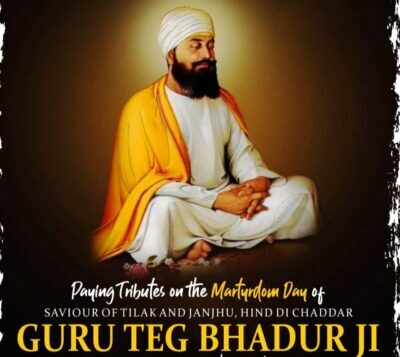
Guru Teg Bahadur Singh’s message of martyrdom was not limited to India;over time, it became the cornerstone of the global human rights movement.
The international observance of Guru Teg Bahadur Singh’s 350th martyrdom year in 2025 is of immense historical,cultural, and political significance-Advocate Kishan Sanmukhdas Bhawnani, Gondia, Maharashtra

Gondia – The global observance of Guru Teg Bahadur Singh’s 350th martyrdom day on November 25, 2025, is not merely a religious tribute but a remembrance of those rare instances in the history of human civilization where a spiritual leader sacrificed his life not for the followers of his own religion, but to protect the religious freedom and human rights of another religion. Guru Teg Bahadur was the ninth Guru of Sikhism, whose life is a symbol of courage and sacrifice. He sacrificed his life to protect religious freedom.His martyrdom day inspires us to stand up for justice, equality, and human rights. His 350th martyrdom day is being celebrated this year, and it is an important day in Indian history. Guru Tegh Bahadur Ji was the ninth Guru of Sikhism and is also known as the “Chadar of Hind.” His sacrifice is seen as a symbol of Indian secularism and religious freedom. Guru Tegh Bahadur Ji was the ninth Guru of Sikhism, whose life is a symbol of courage and sacrifice.He sacrificed his life to protect religious freedom. His martyrdom day inspires us to stand up for justice, equality, and human rights. Guru Tegh Bahadur Ji’s 350th martyrdom day is being celebrated this year, and it is an important day in Indian history.Guru Tegh Bahadur Ji was the ninth Guru of Sikhism and is also known as the “Chadar of Hind.” His sacrifice is seen as a symbol of Indian secularism and religious freedom.This event is unique in world human rights history. During the 17th century, when religious pressure and forced conversions under Mughal rule created an atmosphere of fear and terror, the Kashmiri Pandits pleaded for help to protect their identity and religious freedom. At this time, Guru Tegh Bahadur Singh Ji, risking his life, not only made the historic decision to protect them but also sent the message that the religion of humanity is greater than any religious authority.His publicmartyrdom in Delhi’s Chandni Chowk was not merely a political event but a decisive victory of ideas that established that power cannot control an individual’s faith, identity, and independent thought. The principles of religious freedom, freedom of expression, and autonomy of thought, enshrined in the Universal Declaration of Human Rights (UDHR 1948),had already been established in practice centuries before Guru Tegh Bahadur Ji’s sacrifice. This is why many international researchers and historians recognize him as “The First Human Rights Defender of the Modern World” and “The Saint of Freedom of Conscience.” Guru Tegh Bahadur Singh Ji’s message of martyrdom was not limited to India; over time, it became the cornerstone of the global human rights movement. This sacrifice demonstrates that religious freedom is not just an individual right, but a fundamental value of human civilization. His sacrifice was not a defense of religious identity,but a defense of human dignity, and this is what makes him unique in world history.
Friends, if we consider the message of peace, coexistence, and global humanity: Guru Tegh Bahadur’s legacy in an international context, then in the modern global context, when the world is grappling with the challenges of religious conflicts, racial divisions, cultural intolerance, and extremism, the life message of Guru Tegh Bahadur Singh Ji has become more relevant than ever. His philosophy reinforces the idea that the purpose of religion is not division, but spiritual progress and social peace. He championed the rights of marginalized people, Dalits, oppressed communities, farmers, and oppressed communities. His teachings clearly reflect the ideals of human equality, compassion, fearlessness, and sacrifice. Discussions on topics such as “interfaith dialogue,””peaceful coexistence,” and “religious tolerance” are growing in international forums. The United Nations and various global organizations are striving to advance peace and human rights. Guru Tegh Bahadur Singh Ji’s ideology provides an important context in such global discourse. He explains that religious diversity is not a cause of conflict but a symbol of the richness of human culture. His teachings inspire the resolution of conflicts through non-violence and self-restraint. He strengthened the principle of “Sarbat Da Bhala” (welfare of all) in the Sikh tradition, which is deeply connected to the United Nations’ mission of Global Peace and Welfare. Guru Tegh Bahadur Singh Ji’s philosophy, emphasizing the priority of humanity over nation, religion, caste, and community,can serve as a guiding principle for a world grappling with communal violence, religious polarization, and war in the current global landscape. His enshrined legacy is today the subject of study and research in Canada, Britain, the United States,Europe, Australia, and many countries in Asia. Sikh communities and human rights organizations worldwide celebrate his sacrifice as a symbol of Freedom of Faith and Liberty ofConscience The organization of international conferences academic symposia, and cultural events in his memory demonstrates that his legacy remains vibrant and influential in global society.
Friends, if we consider the global significance of the 350th Martyrdom Year (2025):International Dialogue, the Human Rights Agenda, and the Role of the World Community, then the international commemoration of Guru Tegh Bahadur Singh Ji’s 350th Martyrdom Year (2025) is of immense historical, cultural, and political significance. This occasion reminds the world that the struggle for religious freedom and human rights is not merely a legal or political question, but a human value for which many great figures throughout history have dedicated their lives. Even today, incidents of religious intolerance, minority persecution, racial violence, and thought control are on the rise in many regions of the world, including the Middle East, Africa, Asia, and Europe. At such a time, Guru Tegh Bahadur Ji’s sacrifice serves as both an inspiration and a warning to the global community. On this occasion in 2025, if global leadership incorporates his legacy into the framework of human rights policies, religious freedom protection, peacebuilding, and international cooperation, it could have a positive impact on the world order.It will be important to discuss in international forums whether the world truly accepts freedom of belief as a universal right, or whether human rights still succumb to the pressures of political self-interest, power and ideology.
Friends, if we consider the message of Guru Tegh Bahadur Singh Ji’s Martyrdom Day to the international community, it provides an opportunity to work towards ensuring religious freedom not just in documents, but in practice. Research on his ideology in academic institutions, recognition of his contributions by international human rights organizations, and inclusion of his principles in global peace campaigns could be major achievements of this year. His sacrifice proves that the courage and moral fortitude of an individual can change the course of history.This message inspires today’s generation that raising voice against injustice, oppression, and intolerance is not just a right, but a responsibility towards humanity. If the world community uses this historic occasion to strengthen human values, this 350th year can become not just a commemoration but a foundation for global change.
Thus, if we study and analyze the entire above description, we will find that Guru Tegh Bahadur Singh Ji’s 350th Martyrdom Day is not just a religious event, but a celebration of an important legacy in global human rights history. His life and sacrifice are proof that the principles of humanity, freedom, and peace are greater than any power. In today’s world, filled with conflict and intolerance, his message serves as a beacon, providing direction for the future. His sacrifice teaches human civilization that true power lies not in the sword, but in the courage to stand up for truth and justice. When the world pays tribute to his memory on November 25, 2025, it will truly be an opportunity to reflect on whether we are living up to his ideals and creating a world where every person can live with dignity, freedom, and peace.
-Compiler Author – Tax Expert Columnist Litterateur International Writer Thinker Poet sangeet madhyama CA (ATC) Advocate Kishan Sanmukhdas Bhawnani Gondia Maharashtra 9226229318